A juvenile humpback whale washed ashore near me,
On Dec. 30th, a neighbor alerted me to the whale’s arrival at the surf’s edge. When I went down to see it at about 8:00 a.m., Long Beach police were there and allowed me to take photos.
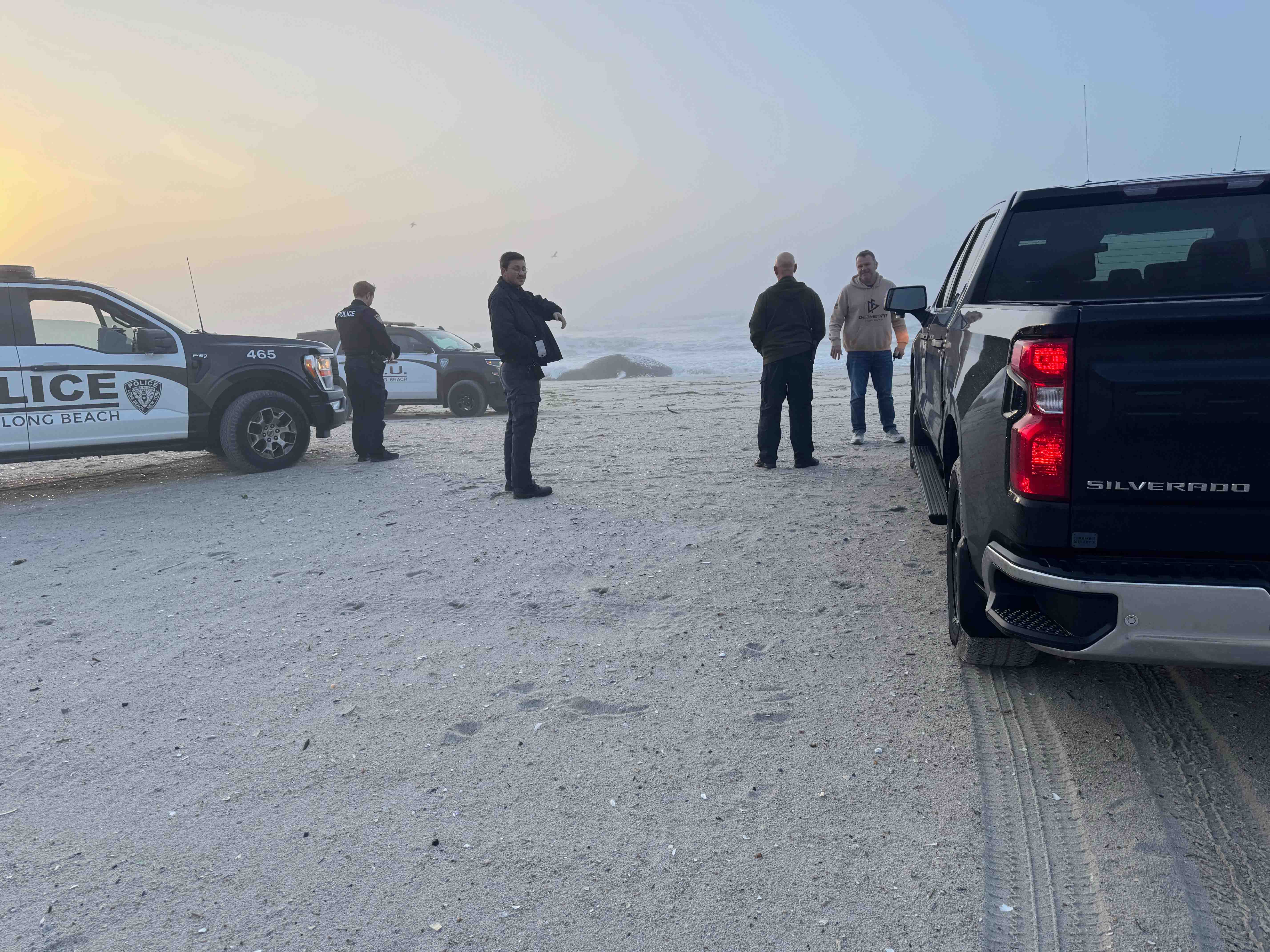
It was a surreal moment. Fog engulfed the sea and shore, but just as I took the shots, the sun breached the fog to cast a hazy glow onto the sea and whale.
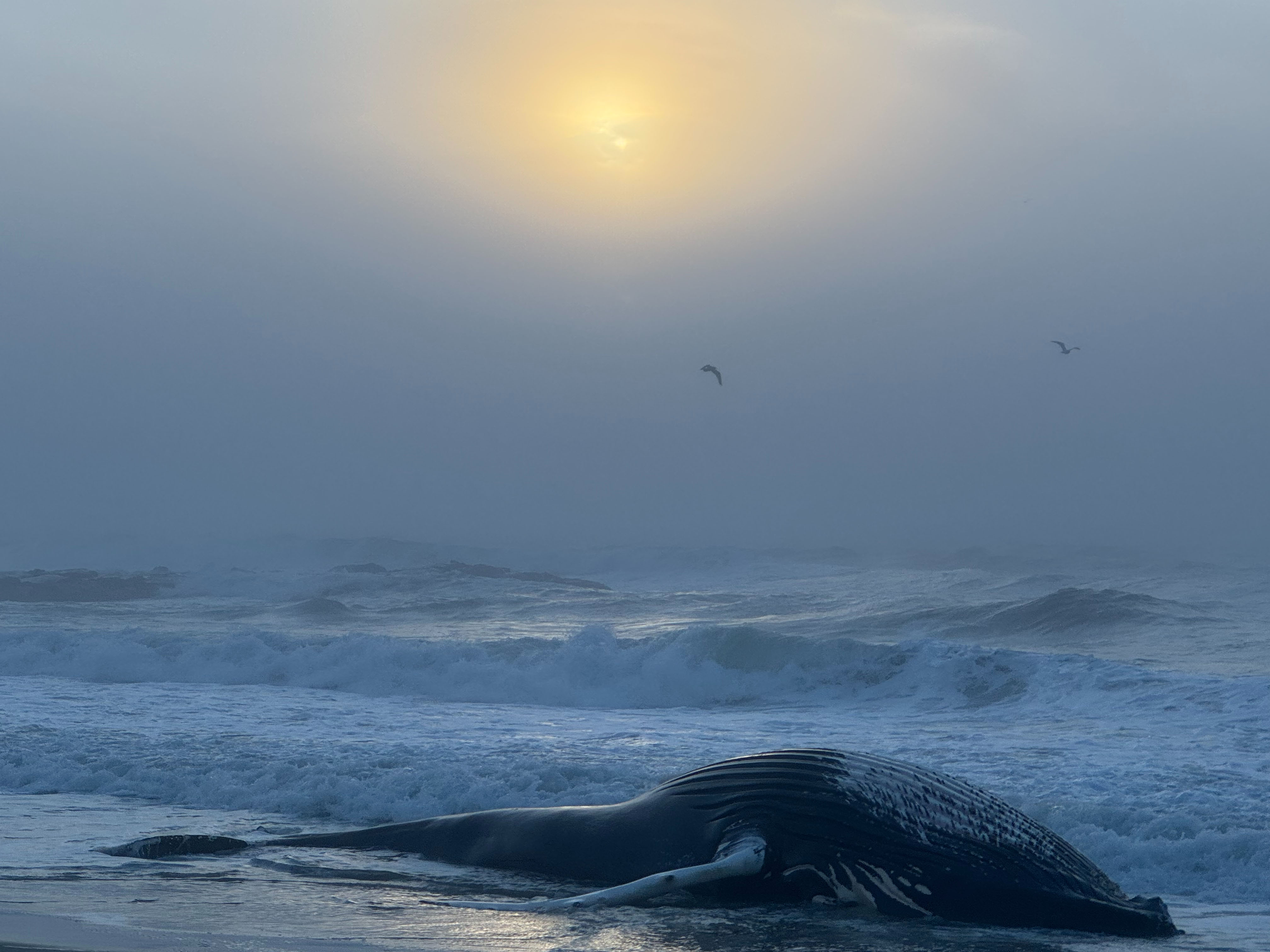
This photo struck a chord in Long Beach. It horrifies and saddens people because we’ve seen many on the East Coast, and this humpback was so young.
We’ve had more whale deaths than usual lately, but we’ve never had more whales near our shore than now, either. Many attribute the whale deaths to the work of offshore wind turbine installations: the pounding of the sea bed and the use of sonar. Some call the windmills monstrosities.
I did some homework and in 2023 wrote in my essay, Whales, Wings and Hot Air.
I concluded that wind projects are not causing these recent whale deaths. Most are from collisions with ships and boats, their steel props, fishing gear, netting, “ghost nets” left adrift, and natural whale sicknesses. I stand by that.
Still, after this whale washed ashore, comments on Facebook’s Long Beach City and Gotham Whale, show many of us still insist it’s—the wind turbine projects that kill whales.

Long Beach residents vehemently opposed the installation of wind turbines 15 to 30 miles off our shore, and the project was halted. That project would have provided power to up to one million homes. However, another project further west continues. That Empire Wind project, also between 15 and 30 miles offshore, will furnish power to 500,000 homes in New York. It’s expected to be in commercial operation in 2027.
I believe the main reason people were resistant to offshore wind turbines was their potential effect on horizon aesthetics. Sure, we all love our horizon; we look at it in wonder. Only the long row of container and tanker ships lines our horizon right now.

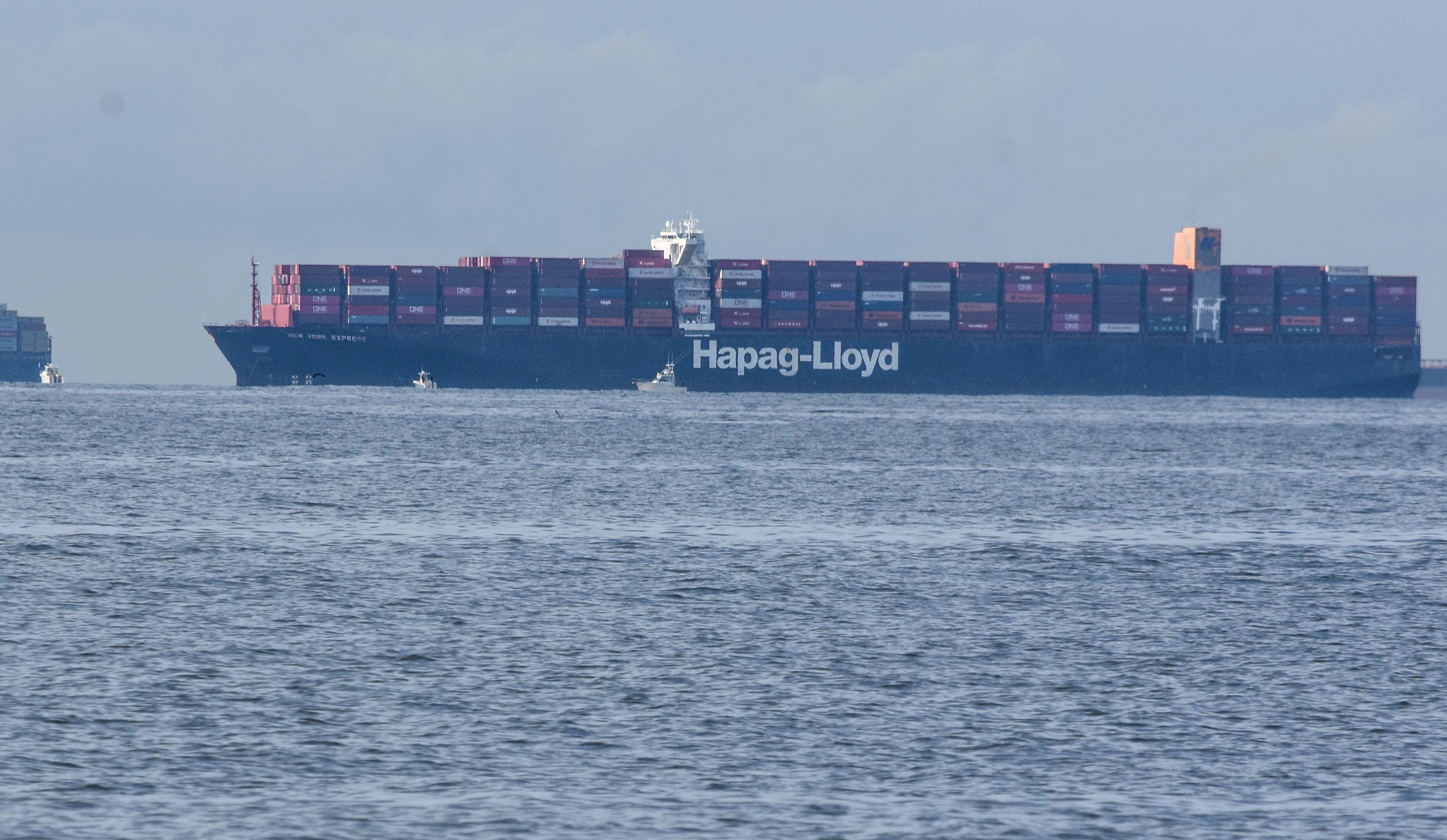
These ships are so ubiquitous they have become icons of Long Beach’s horizon. I often include them in my photo essays.
Of course, a sleek sailboat would be prettier, but juxtaposing this “monstrous” ship and the flock only enhances the lacey flight.

Wind farms and solar power are necessary due to climate change, which has been on our planet’s horizon for decades.
Many said climate change, first called global warming, was a hoax. We chose disbelief over action. Much as we did when alarms were raised about smoking and lung cancer. “There’s no definitive proof,” we were told about smoking and cancer, and so many died—needlessly—for lack of action.
Now, as we try to take action on this climate cancer, there is again resistance.
But we must persevere against the fossil fuel industry as we did with tobacco companies.
Sea turbines will be placed beyond the horizon. But even if they are visible from shore, couldn’t we get used to them, given their value?
Advances in technology are often met with resistance, but the value of the tech supersedes the change in our surroundings.
Our streets, avenues, and boulevards are filled with power lines draped through trees, across streets, and above beautiful gardens. But we are so used to these lines that we never see them. We take the “telephone” poles that hold up these lines as part of life. We accept them because their service outweighs the disruption to our beautiful streets.
Back in the sepia days of old, the bucolic streets of America were threatened by the arrival of the infernal combustion engine.
Its earliest arrival motivated Red Flag Laws, which required drivers to have someone walk ahead with a red flag to announce a horseless carriage’s arrival. Maybe we should do that today.
We got used to these “monstrosities” because their utility and value outweighed their nuisance.
We in Long Beach are particularly vulnerable to the effects of rising sea levels. But as we’ve recently seen, even inland Americans are at risk of climate change storms. One would think we’d welcome the advance of technology to mitigate these threats.
Some among us think wind turbines are acceptable, but not in my backyard, NIMBY, or on my horizon.
Our blue planet is finally waking up to the real threat of climate change, but it is still challenging to make progress. We’re told, “We’re gonna drill baby drill!” Our flood insurers respond, “We must Bill, baby, bill.”
Nothing compares with the view of the sea’s surface, calm and flat, then tonnage of mammal, jaws agape, bursts through it.

I see people lining our boardwalk rails, pointing and laughing, in total awe of our mammal kin putting on their aqua show.
Long Islanders, even people out of state, come from miles around when they hear the whales are back.
If you are in awe of nature, please temper your admiration with the knowledge that what you see survives despite our deadly habits. We haven’t been good custodians of our sea life. We’ve overfished it and fouled it with oil, plastics, and chemicals. We wouldn’t live amidst such garbage in our homes; why do we force it on sea creatures?
NOAA reports that in 2022, off the coast of Florida, a sperm whale died after ingesting intertwined fishing line, net pieces, and parts of plastic bags. All this plastic killed the mammal because it could no longer digest its food. The whale was forty-seven feet long and thin.

We need to take better care of our sea mammals and all wildlife. Don’t ya think?
Some of us do it personally, as I wrote about here. Sure, picking up trash on the beach might not save the whales, but it might save a shorebird, and that’s important, too. It also tends to set the tone of what’s expected from us “civilized” mammals.
Others try to make substantial differences by stopping the use of ghost nets, the killers of whales, dolphins, and sea turtles. Ghost nets are abandoned fishing nets whose floats cause them to lie perpendicular to the seabed, snaring and killing whales and many other sea creatures.
Of course, we are all sad when we see a whale washed ashore, especially a juvenile like the one that washed ashore here in Long Beach, NY.
But to those blaming wind turbine construction and sonar noise, where is your fervor against whale entanglements, shipping speeds, and boat traffic?
Shipping traffic in the New York Bight has increased by over 34% in the last five years, and modern ships have sped up. Shipping rules dictate that mariners slow down in specific zones for whales.
In voluntary speed zones, non-compliance is 90%, and in mandatory zones, compliance is also dangerously low. More whales are now amid more ships moving faster than ever. (Save Coastal Wildlife)
On rare occasions, when mariners spot a whale, they can’t avoid it due to their vessel’s speed. According to Friends of the Sea, ships kill over 20,000 whales globally each year.
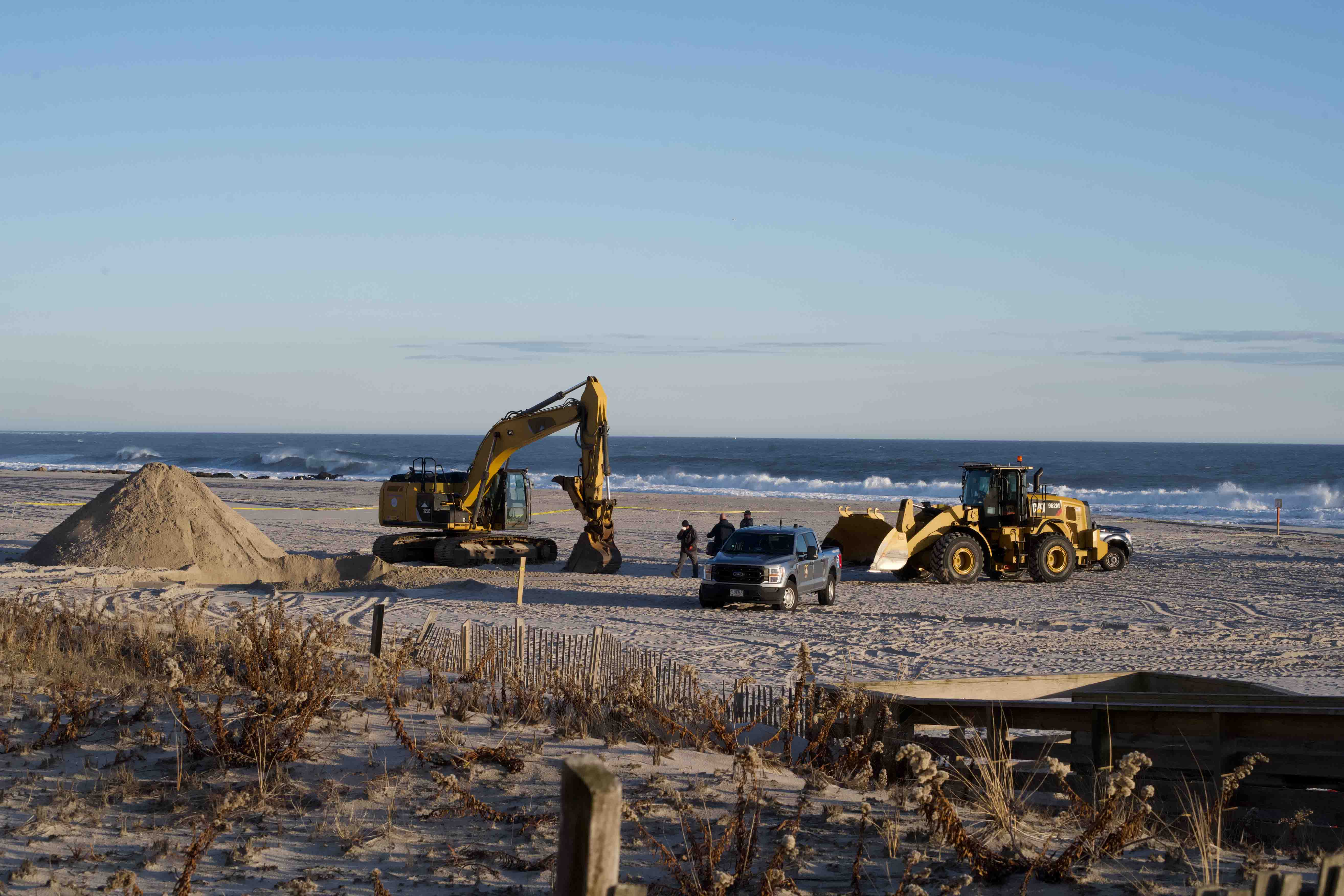
According to lead researcher for Gotham Whale, Danielle Brown, “The more time these whales spend in the New York Bight apex may mean increased exposure to human activities, including busy shipping traffic leading into the Port of New York and New Jersey.”
If you only have time to click one link in my essay, please click this article: “OMG! Stop Lying About Whale Deaths!” in Save Coastal Wildlife, which contains a wealth of information that is extremely useful for people who want to learn the truth about whale deaths.
If you oppose using sonar to scan seabeds for windmill placements, where has your zeal been to prevent dangerous acoustics from being used in seabed gas and oil exploration?
According to Erica Staaterman, PhD, an acoustics expert with the Bureau of Ocean Management (BOEM), “The sound used by the wind industry is likely to be outside the presumed hearing range of humpbacks.” She said, ” The sounds are also far quieter than those emitted during oil and gas exploration, which employs air guns to map deep beneath the sea floor.”
MS. Staterman states in a BOEM graphic: “There is no evidence that HRG (High-Resolution Geophysical) sources used by offshore wind companies could cause mortality of whales, nor any evidence that they are responsible for the recent whale strandings.”
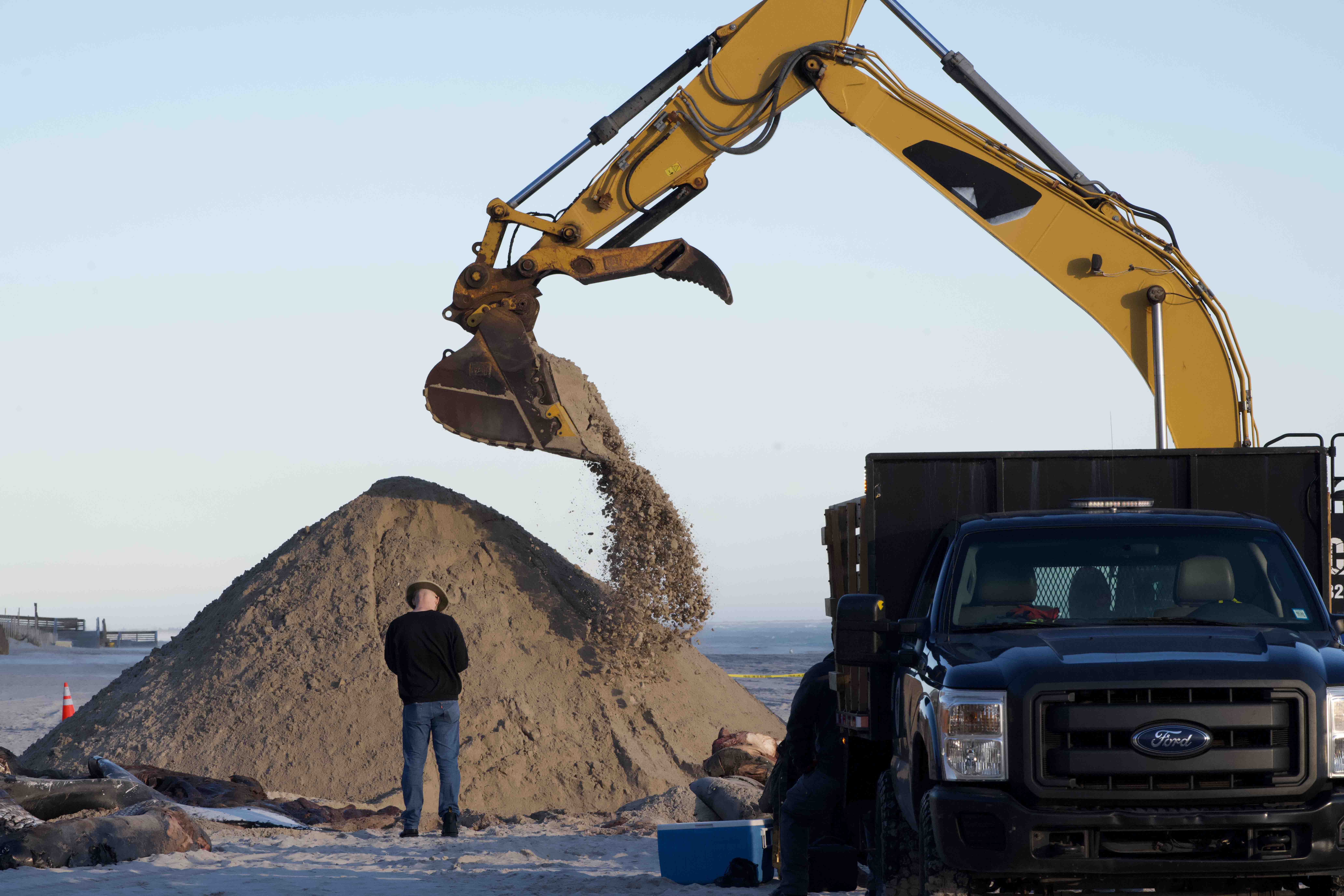
Sonar is only temporarily used to scan for turbine and cable placements, but gas and oil companies continuously use air guns in oil and gas exploration.
Windmill sonar is used to ultimately mitigate climate change. Fossil fuel’s exploration’s use of air-gun sonar ultimately contributes to climate change—which is why we have this damn problem in the first place.
None of us wants to see whales harmed. This juvenile whale’s life was cut tragically short. A preliminary necropsy determined blunt trauma was evident, as was evidence of previous entanglements.
I hope this death and the subsequent exchange of opposing views will lead one or two whale lovers to reconsider their opposition to offshore turbines.
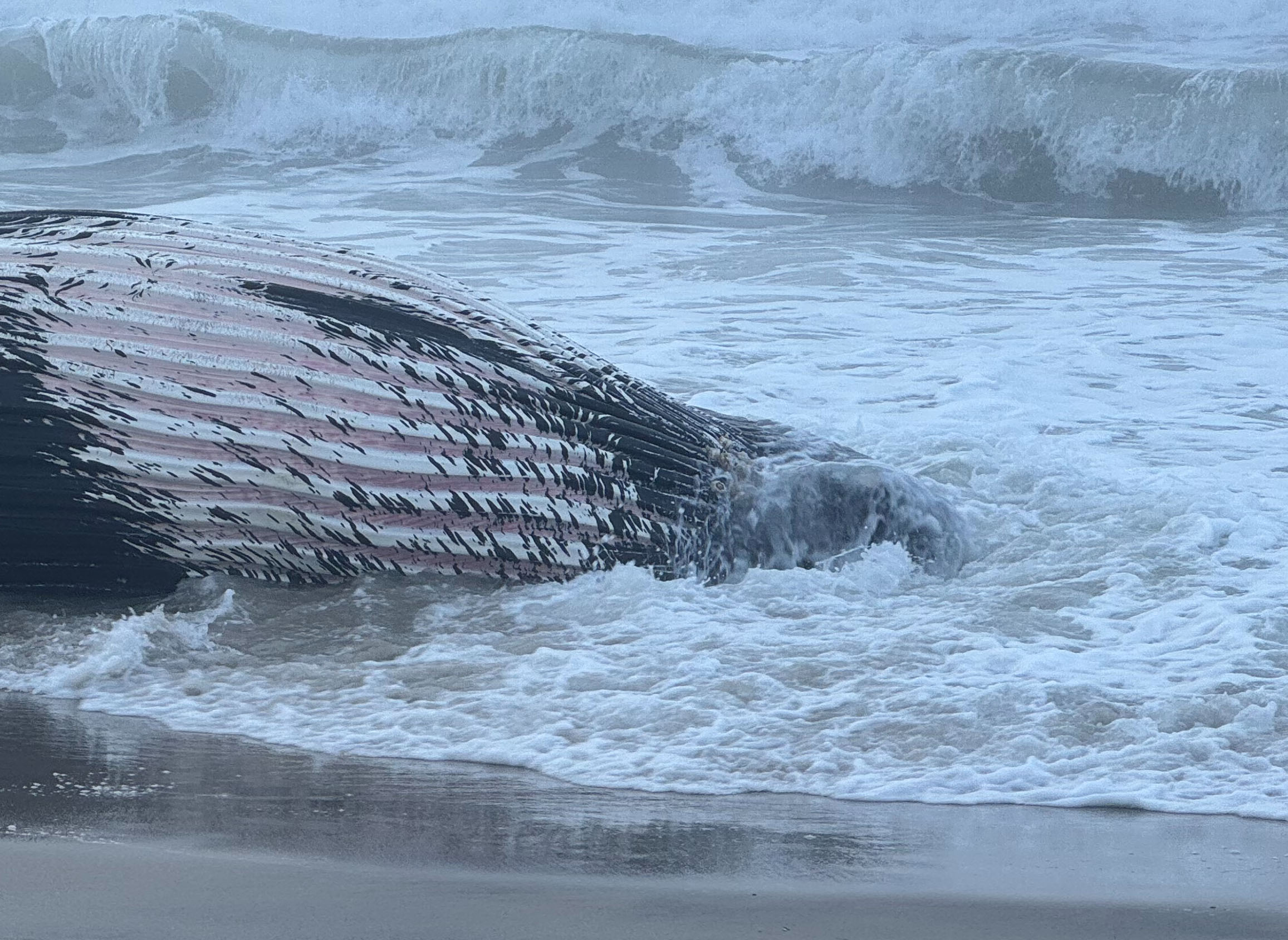
Whales can be identified by their markings, which are similar to fingerprints. Gotham Whale’s Artie Raslich informed me that this deceased Long Beach whale is in their registry # NYC0393.
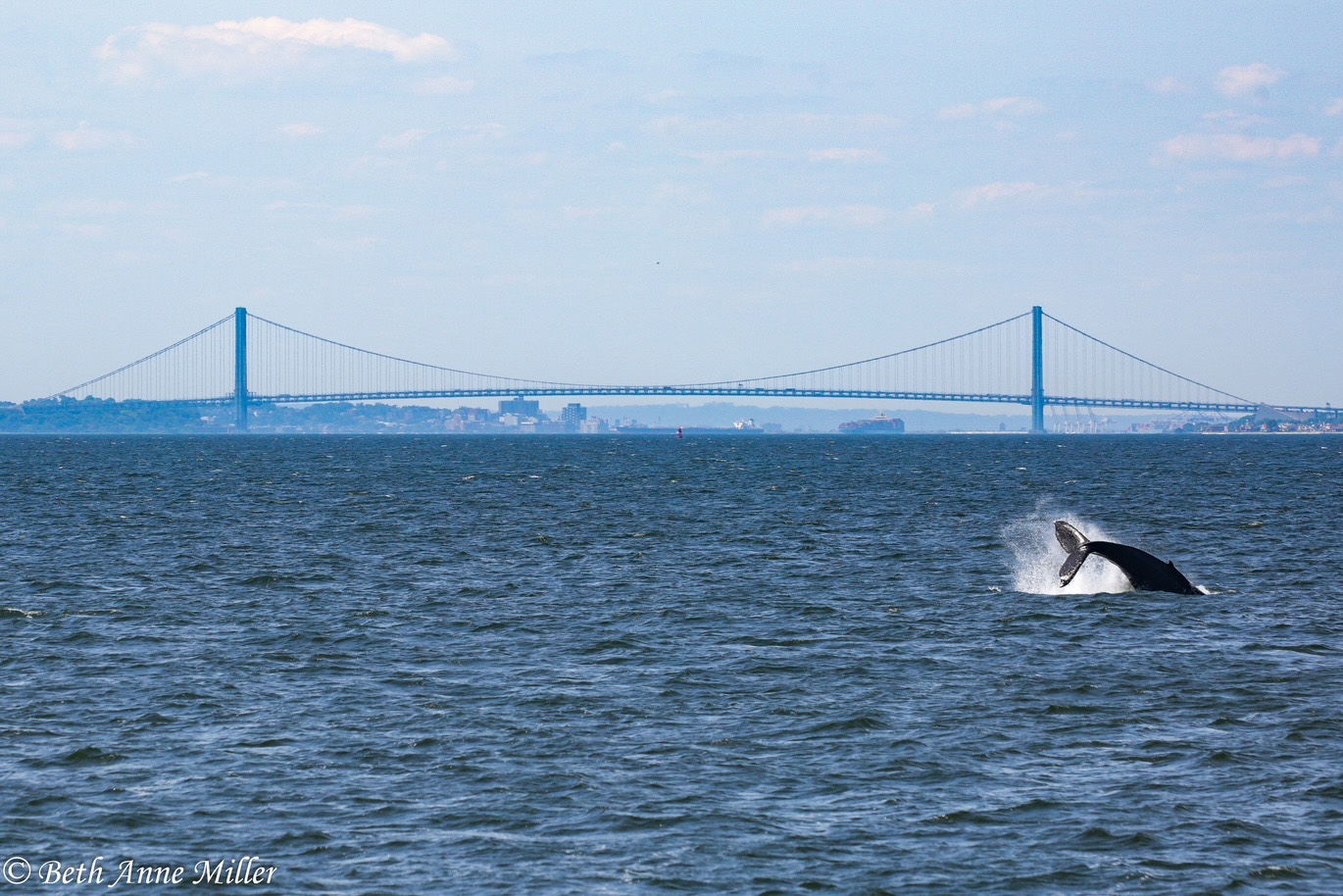
Two photographers happened to capture # NYC0393 while she still shared planet Earth with us.
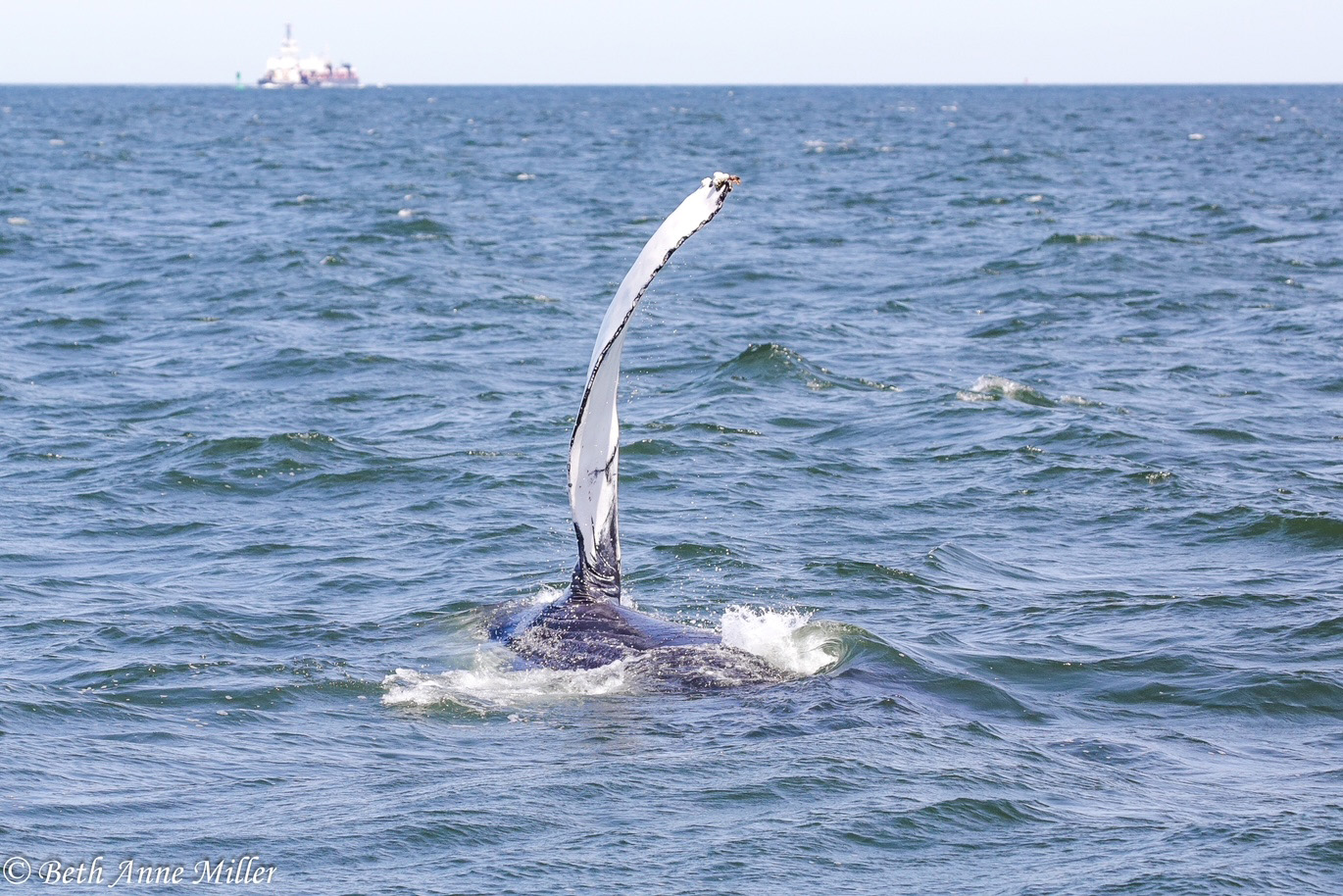
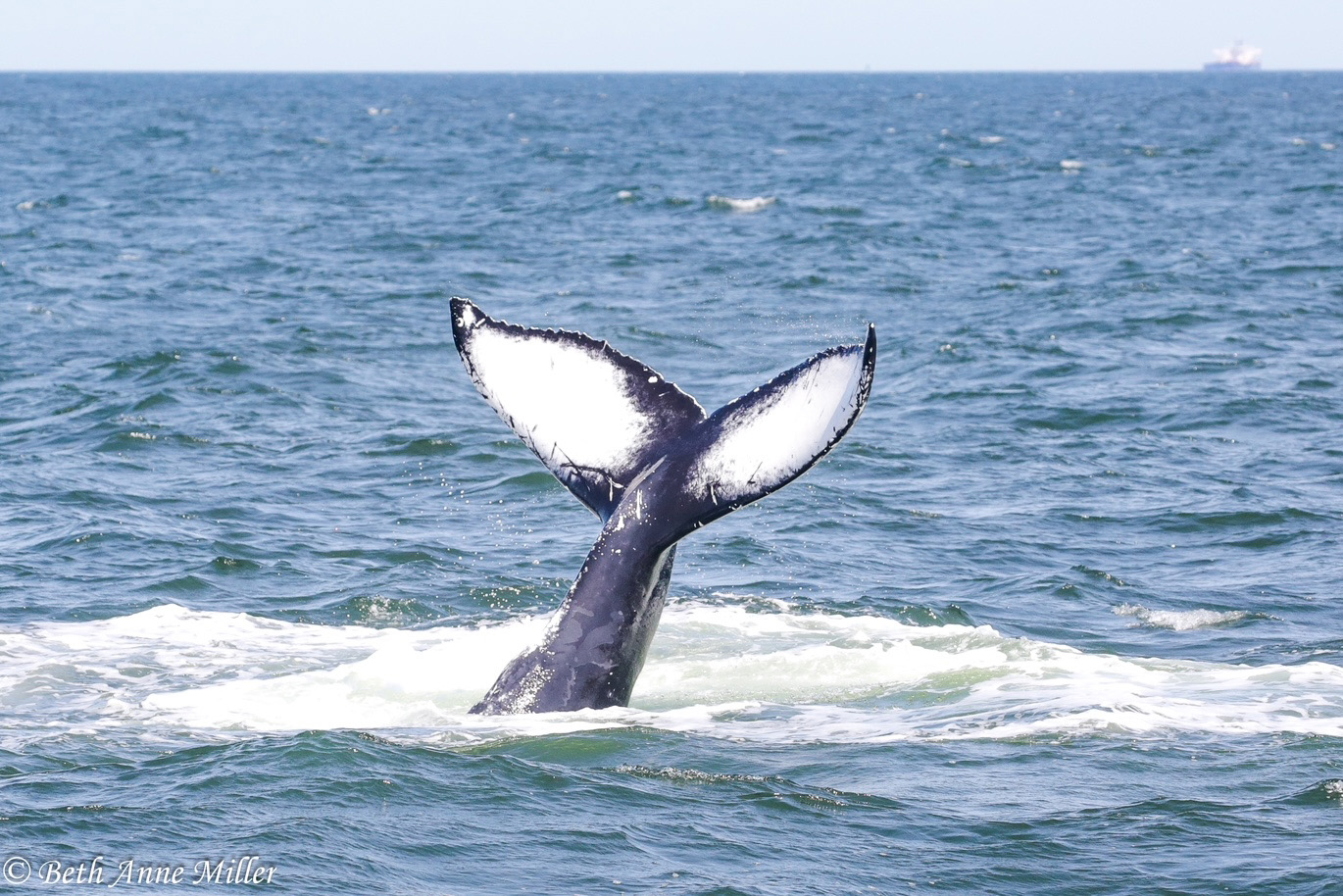
Chris St. Lawrence, who was on American Princess, photographed the female breaching. Beth Anne Miller photographed her tail-slapping and diving near the Verrazzano Bridge. These were the whale’s last months on Earth.
She, and 20,000 more globally, will no longer breach for us…

…or tail slap for us…
…wave for us…
…or dive for us.
On the last day of 2024…
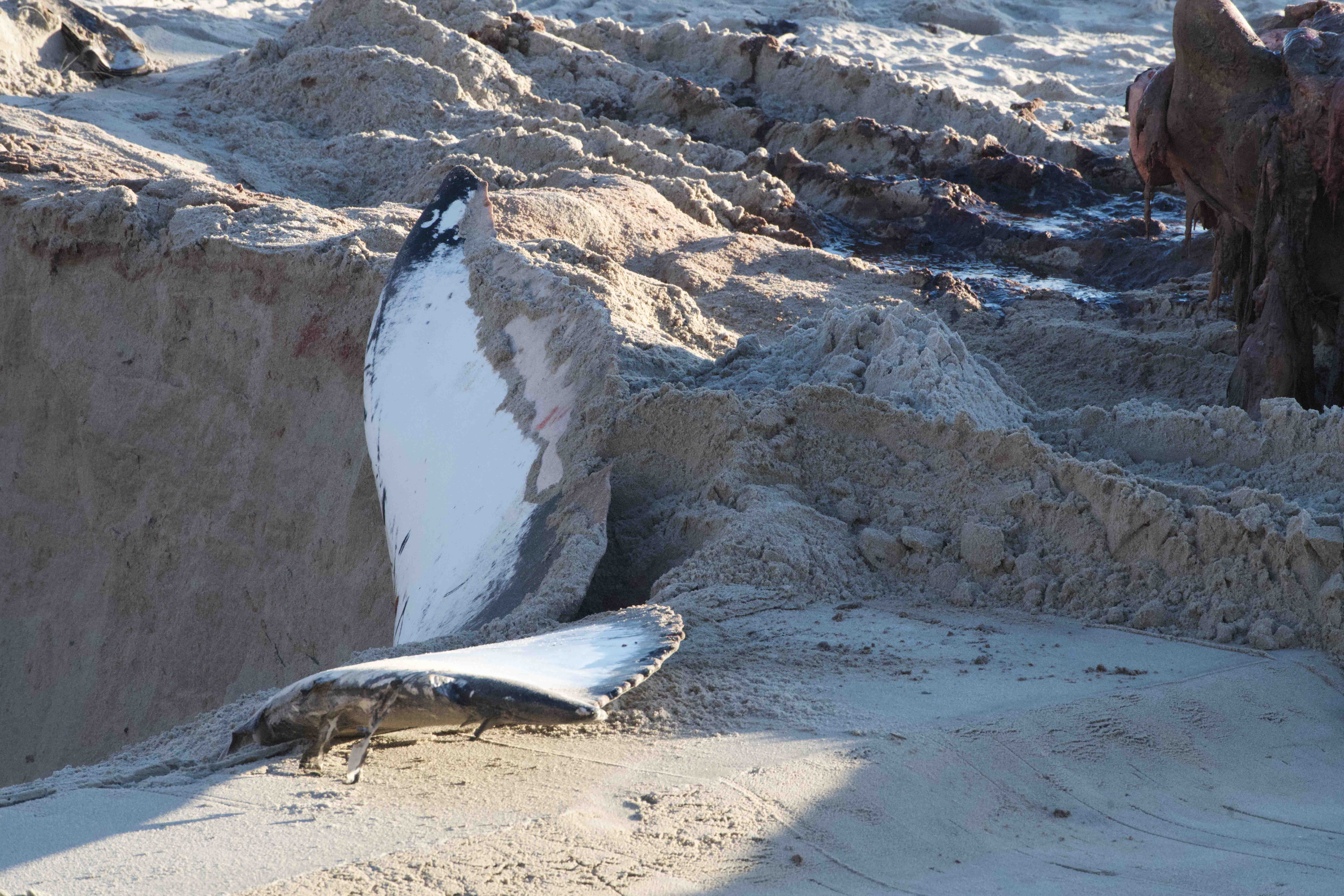
…she was sent beneath our shore…
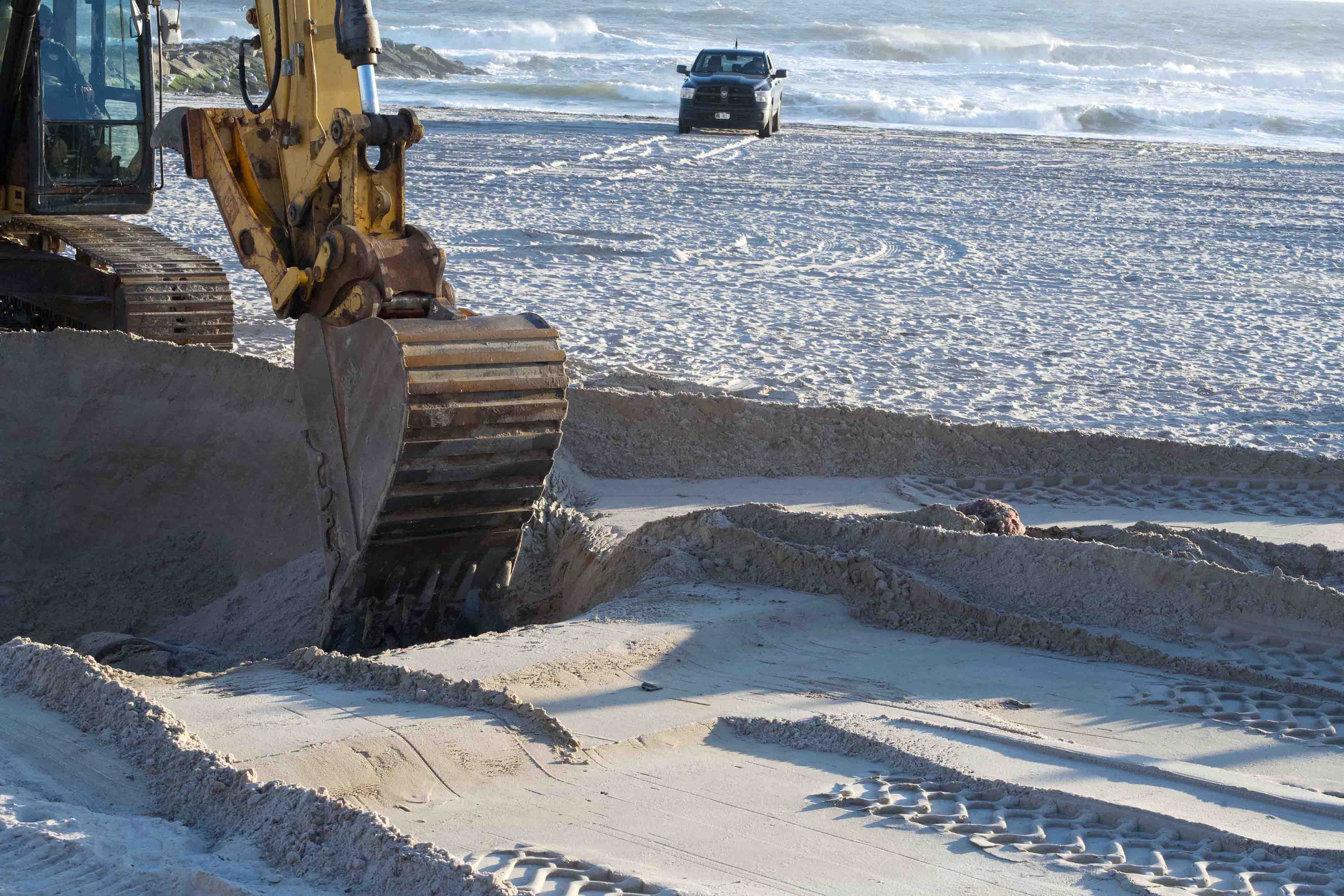
…forever gone from us.
Be well,
Leebythesea
See my beneath the Apple blog, https://wherethesundontshine.net
Categories: Whale deaths


Richard, thank you. Glad you liked the essay and photos. You seem to have a deeper knowledge of the issue as far as shore distances, etc, than I have. I’m happy to hear what you have to contribute. If you have graphics about the issue, you might want to consider sharing them on Long Beach social media. But if you don’t want to I completely understand. But thanks again for your diligent input.
Be well’
Lee
LikeLike
Liz, thank you for your comment. We do need to see from the minds of both sides in this or any matter. You sound like a very wise woman. We need to keep open minds, but we also must act on the most recent, scientific, and reliably supported information we have. I think I’ve found a lot of it, and presented it here. Thanks again.
Be well;
Lee
LikeLike
Kim, I guess so. I would think a lot of thought and investigation goes into the areas chosen. it must have a lot to do with seabed, geography.
Thank you for your comment and interest.
Be well’
Lee
LikeLike
Excellent writing and fabulous pictures. Congratulations.
FYI – As you note, Empire Wind 1 project is still on track with installations beginning next year I believe. What many on Long Beach don’t realize is that the turbines for Empire Wind 1 are the ones closest to LB shores. The project which has been stalled (Empire Wind 2) has its turbine array furthest off shore.
LikeLike
Jake, what memorable experiences you’ve had, off Scotland? Wow! Yes, the whales face so many challenges to stay alive, from ship props to plastics and chemicals too. Thank you for your comments.
Be well’
Lee
LikeLike
Beth. thank you for your kind words and for the contribution of your beautiful photos. Little did you know when you captured her you would be recording her last days with us. But maybe her death will bring needed focus on the deaths of whales.
Be well,
Lee
LikeLike
Beautifully written and thoughtful essay celebrating this whale’s short life and looking at what might have been the cause of death. It’s such a joy to see so many whales off our shore, and so devastating when one meets a tragic end here.
LikeLike
I have the feeling that Pollution may also poison many of our Apex feeders. I remember fishing [ 80 yrs old ] off Scotland light on party boats in the ” Acid waters ” which were often various colors, orange, Turquoise, Red, etc…..The bottom fish are feeding amongst ancient rusting barrels of toxic waste for sure. The dredgers were banned from working off Staten Island because it would stir up the toxic waste lining the bottom.
I suspect the anti wind motives……I think some are paid by the Oil and Gas lobby
LikeLike
hi lee. Thanks for your article. I have a question in terms of where the turbines can be placed. Couldn’t it be done across Jones Beach which is not a residential area and have the same output of power as placing them here?
LikeLike
Thank you for a well researched and informative article! I’ve been watching and listening to both sides for a while. I’ve been saying a lot of what you wrote down here (but you’ve stated it much more eloquently lol) .If people are saddened by these deaths, they can’t take a “one sided approach”. You must see the world as a whole and we all must do our part to help the planet the best we can.
The brainwashing going on in this country is mind-boggling.
LikeLike
MJM, thank you. Glad you appreciated my perspective. Enjoy life. Carpe the hell out of it.
Be well,
Lee
LikeLike
If only more folks had your outlook on life!✌️
LikeLike