First, never give up. Second, never give up.
Most of us think life is hard until we see the hardiest among us.
Long Beach, NY’s library archivist Aliza Hornblass asked me to partner with the library in their oral history project (soon to be updated), recording people for their Long Beach perspectives. I agreed; it’s what I do anyway.
My first subject was Long Beach City Council Vice President Elizabeth Treston.
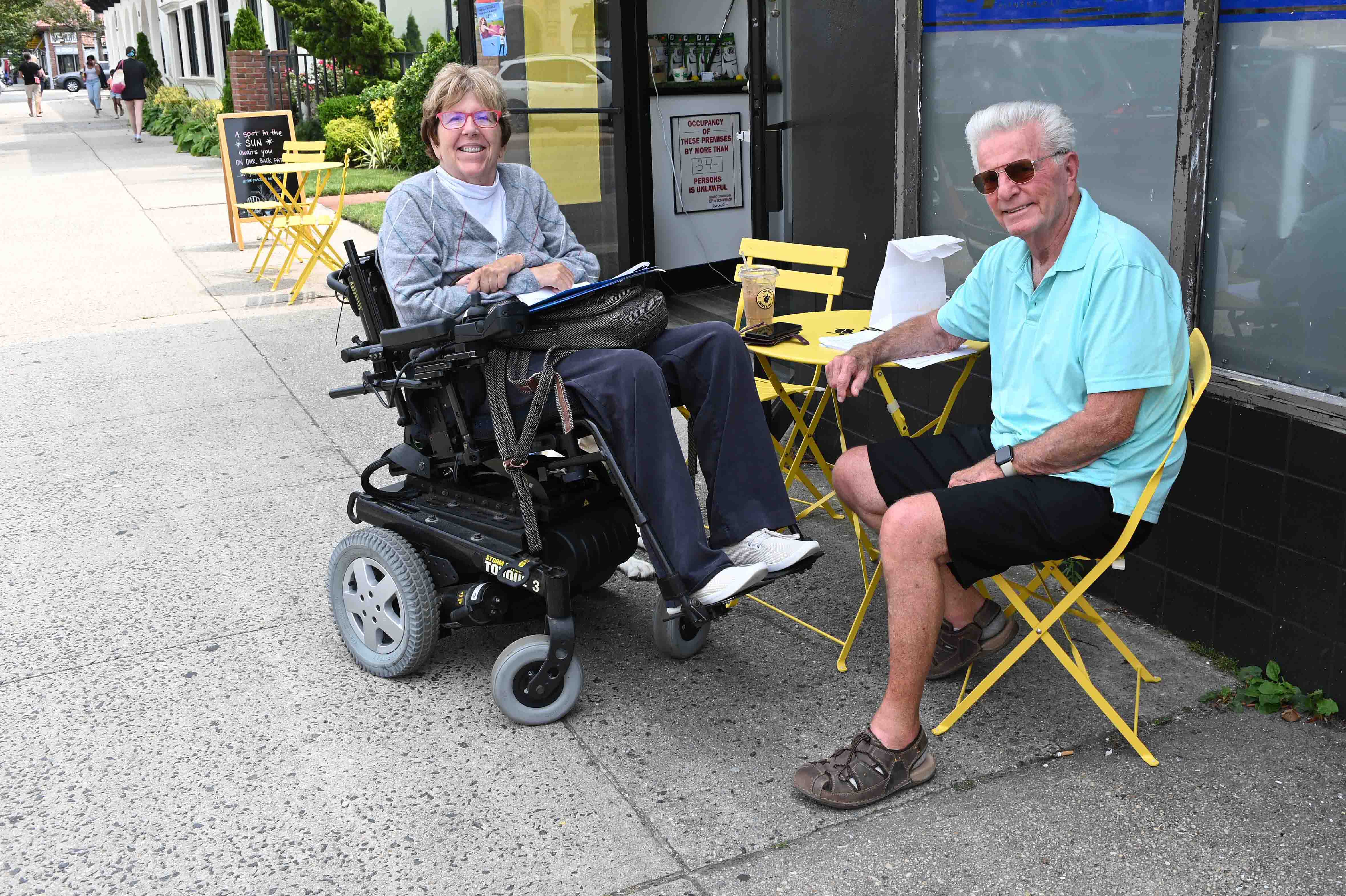
I met Liz for the recording at Coffee and Tee, yes, TEE, a coffee house on Park Avenue. I conducted two interviews: the oral history, in a more formal question-and-answer format, and the second, for this essay, a more casual chat, including my views—if you can endure even more of them. This essay contains information from both interviews.
We sat outside Coffee and Tee, which was quieter than inside. Outside also included street sounds that a future listener might appreciate; the sounds of Long Beach in summer, one hundred years from now—when Long Beach was not under twenty feet of the North Atlantic.
Liz uses a motorized wheelchair to get around town; a traumatic diving accident paralyzed her, basically, from the shoulders down. But that dive never paralyzed her spirit.
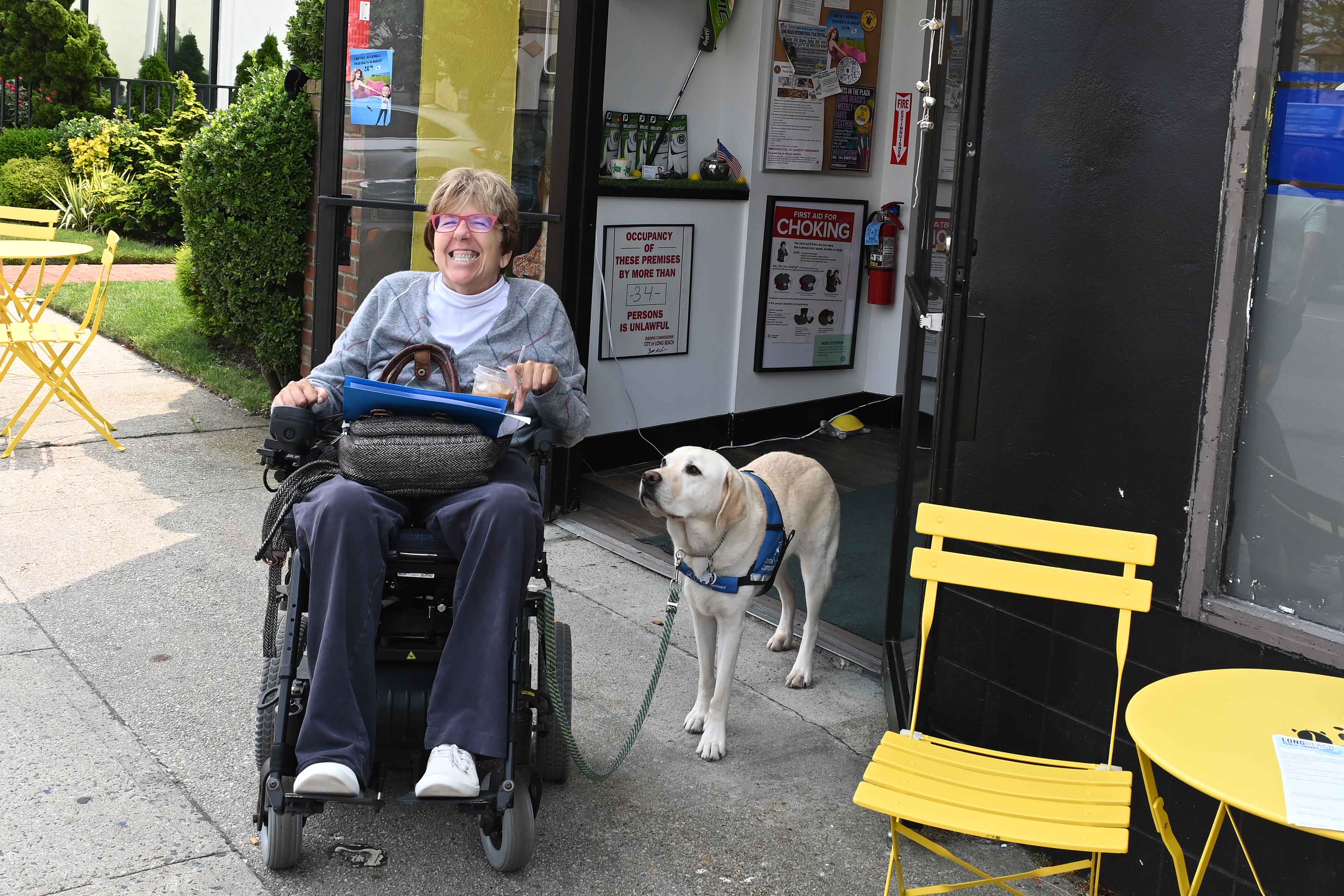
Liz said, “Everyone is faced with a challenge every day, and how you approach it is how you live.” She said, “I come from parents who said you never give up; you just keep going. That’s what I did; there was really no option.”
A good part of that spirit came from her 87-year-old mom who lives with Liz in our West End. Her mom, a nurse, retired at 84 but returned to work briefly to help during the covid crisis. (See, never give up.) Liz’s dad worked for Con Ed.
Mom, an early woman’s-issues and ERA supporter, took Liz to various fundraisers. It’s apparent Liz inherited her mom’s passion. She gets stuff done.
Liz’s family has deep roots in Long Beach. Her grandma moved from the Bronx at the start of our Long Beach centennial year, 1922, and became a school custodian. Her grandad was an NYPD detective. At one point, grandma lived with all “nine or ten” of her siblings on West End’s New Hampshire St.
Liz laments the changes in today’s West End. She recalled the old day when everyone would buy their bathing suits at Weinstein’s. She said, “Women changed in the middle of the aisle.” Now it’s become gentrified she said. Tall buildings on small lots. Lost street parking due to wide driveways. It needed better planning.
After the accident, Liz thought her nursing dream was impossible—she later learned it wasn’t— so she studied speech therapy and pathology toward a Masters’s degree at Hofstra. That led to United Cerebral Palsy, helping non-verbal children by day and grad students at night—for twenty-five years. She retired from that career, but she still wanted to help others.
So she ran for office.
City hall was turning our beautiful surfing City by the Sea…
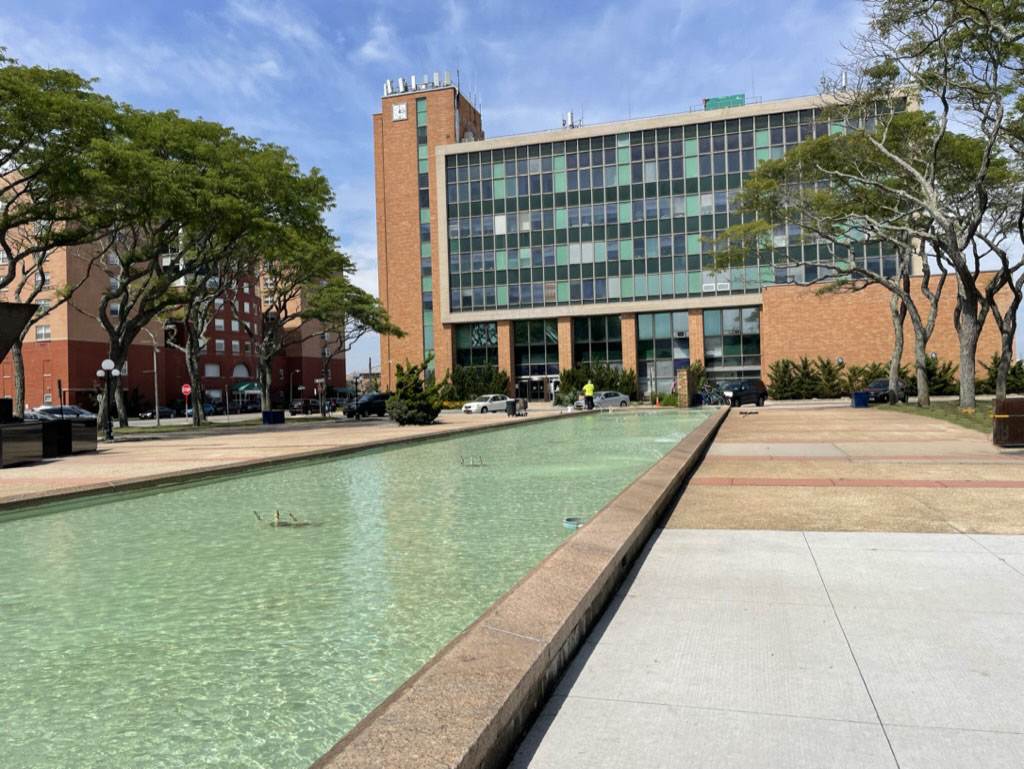
…to Serf City
Long Beach in 2019 was in dire financial straits when Liz was elected Long Beach City Councilwoman. Mismanagement prevailed in our City by the Sea. The administration was, Liz said, “not doing what they were in charge of doing…It had gone on for decades.”

But things changed when the new City Council hired an outsider, Donna Gaydon, as City Manager. Liz said, “She (Gaydon) was focused on the finances that were a hot mess. She was well respected and not tainted by Long Beach.” Our City by the Sea had been borrowing—just to pay its bills.
Liz said there would have been no tax increase this year if it hadn’t been for the Haberman suit. (The Haberman lawsuit over oceanfront property had gone unaddressed for decades—fe$tering.)
Liz said, “When we started, we were in the red; now, we have a positive fund balance. If we did not have a positive fund balance and if our ratings had not been increased three times, we would have sanitation once a week, no recycling, and you could forget about our beautiful clean beach, if we were continuing to borrow to pay our bills.”
A city council job is part-time, but dedicated members make it full-time; as such, Liz reads legal papers when she gets home. “I haven’t read a book in four years,” she said. That speaks of dedication, integrity.
Even on her drive to work at City Hall, she takes different routes to see what’s going on in the city or to follow up on issues residents told her about.
One route took her to the profane flags that fly on a busy Long Beach street. Of those banners, Liz said, “They are malicious, triggering, and divisive, but they are not on city property,” the flags’ flyer “has the right to say what he wants, and I’ll protect that till the day I die.” I photographed and spoke about those flags in my essay, Passions, Private, and Profane.
Hurricane Sandy still looms large in Long Beach’s memory. Liz said, “Because there was a prior storm (Irene) that did minimal damage, by and large the City did not evacuate. By the time we got the notice that we should get out, the bridges were closed. Then we could not.” She said the second high tide brought water flying down her West End block. She said, “There were white caps in front of my window.”
Liz said, “I don’t know if Long Beach will be here with our warming climate and our sea level rises. I think this may be my warning for the future that we need to do something about climate change that’s actually real.”
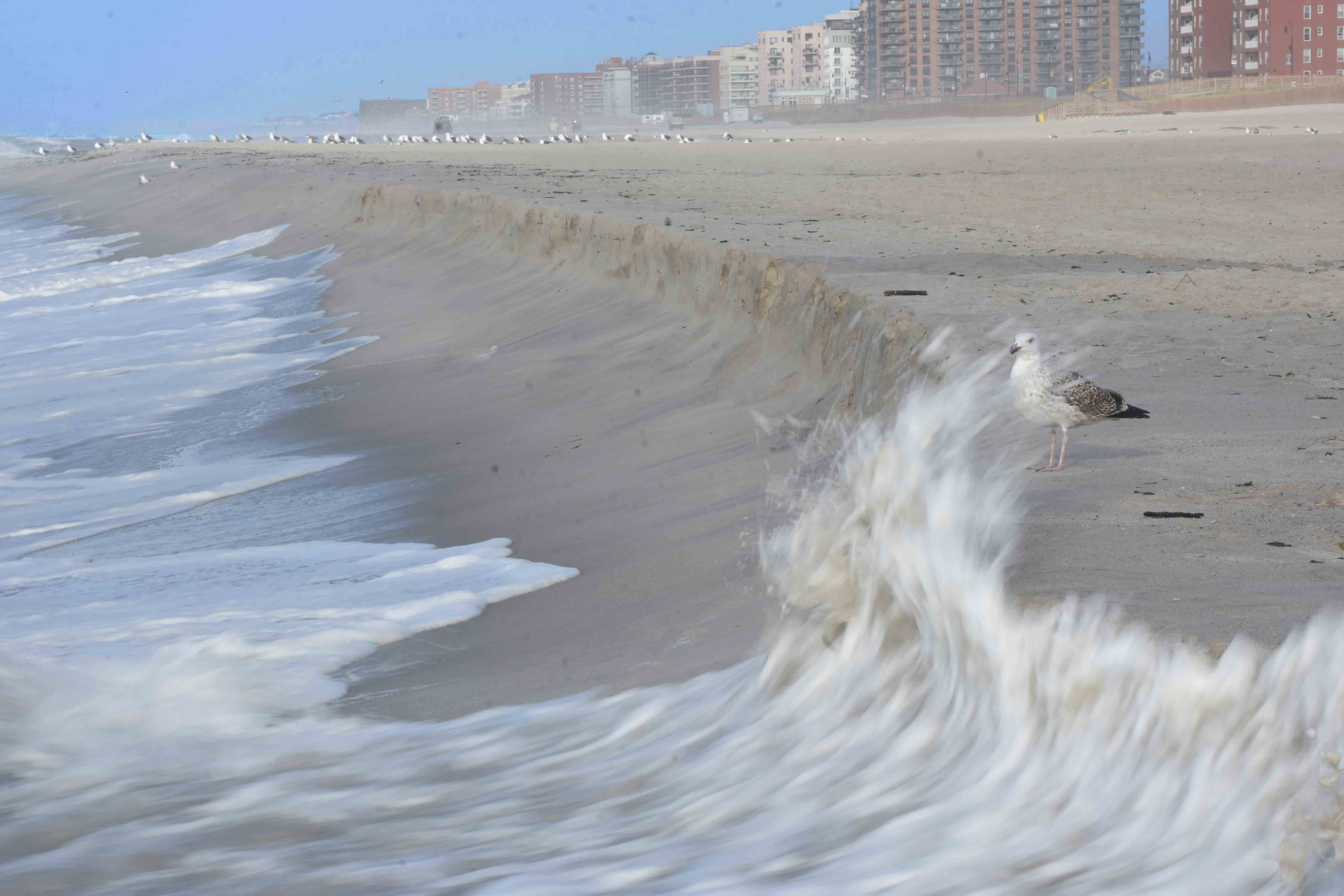
When I asked about local and global barrier island development, she said, “I’m on a board for sustainability, an international board, and we look at it globally, and the consensus is that living on the coast is really dangerous because of the rising sea levels. FEMA says, don’t build, or if you are going to build, build smart. And unfortunately, they are not building smart because it costs too much money. So there needs to be a balance now between developers and builders that come together, you know permeable pavements, putting black tops across your city, is not the answer. Let’s listen to those that have the science and start changing the way we already do things. Because it’s not working.”
Regarding wind farms and other renewable energy, Liz said, “I am all for renewable energy however that happens, as long as it’s safe and proven.” Yes, safe, as I said in my previous essay, Whales, Wings, and Hot Air.
I asked Liz if she had a message for listeners of this interview one hundred years from now.
She said, “I hope one hundred years from now we are not as divisive as we are today…I just hope the human race is still in existence a hundred years from now because this current path with people despising each other for the silliest reasons, I mean actual hate, where people actually hate each other, is mind-blowing. I hope there are generations here, and you’re not living in a silo.”
I think a common foe draws adversaries together. Maybe if we see climate change as our common foe and rise together in defense of our home, planet Earth, we can curb divisiveness and help the cause. Global temps are rising as I type. Yes, we have to ensure windmills are safe for us. We also have to fight like Ukrainians, never give up, and throw everything at it. As Marine Col. Chesty Puller said, “If we run out of ammunition, we’ll go to the bayonet.”
Right now, our bayonets—are windmills.
I asked Liz if residents approached her in the street or boardwalk to vent. I was surprised when she said, “They don’t know me; they know the dog, Macgyver.”

Liz got Magyver from Canine Companions for Independence, her fifth dog from them in thirty years. Liz told me, “They are trained to know over 60 commands; each dog has been matched with me depending upon what I was doing in my life, for example; Taylor, my first dog came with me to work as a speech pathologist every day he was essentially the first facility dog that worked with children with disabilities.” See Macgyver graduate in this Pup and Circumstance video to service Liz. If you’re looking for a fantastically rewarding volunteer job, check it out.
Liz also spoke of our local Posh Pets animal shelter and urged people to adopt dogs—not buy them. She said Posh Pets receives no funding from Long Beach.
Liz said so many unsung people offer help to our residents from “the shadows,” people who help privately rather than those who say, “Look at me, look at me.” These private people “go without citation.”
She said giving affects kids in the household. She recalls her Godfather, who would bring her family money to help with tuition but never came into the house. When he got older, they were able to help him.
Liz said people who do good things for others feel good about it, “It’s a physical thing,” she said.
I asked Liz what she thought grads today should consider as a career. I was surprised when she said, “Become psychiatrists.” She said, “There are not enough people to deal with the people who have problems.” She pointed out the high suicide rate among young people.
I thought she was spot on with that suggestion. We discussed how mental health issues are often behind most societal problems, crime, and homelessness among them.
FYI, A few of my discoveries about American mental health:
The National Institute of Mental Health, reports that one in five Americans suffer from mental health disorders. That’s fifty-three million Americans. Thirteen million Americans have a severe mental illness. Nine million Americans have both a substance abuse disorder—and mental illness.
US Dept of Justice reports about 43% of state and 23% of federal prisoners had a history of a mental health problem. See, America, it’s Intervention Time
We spoke of local meditation and mindfulness efforts. Liz informed me that Long Beach schools cover mindfulness to some degree. Also, the Long Beach library does Meditation on the Beach. I think we need to move away from so much, me, me, me, grab, grab, grab, and meditation helps.
I asked Liz what she thought her most significant accomplishment was in serving Long Beach.
She paused a moment or two. I could see she was putting careful thought into her response.
Finally, she said: “If you are comfortable in an uncomfortable situation, it’s still comfort. So when someone comes from outside and points out to you, you’re living in dirt, you say, we’ll I’m comfortable living in dirt. (And they say) well, let me offer you a floor, you move over to the floor, and you say, ‘Oh, this is more comfortable; let me sit here.’ That’s what she (Donna Gaydon) did. Now, we are too comfortable on the floor; let’s move to a carpet.”
That was an effective way to describe Long Beach’s sad replays. I also think it applies to many of our personal situations: relationships and jobs. Comfort with the uncomfortable can disable and immobilize us, enabling a crappy situation to continue.
It reminded me of a saying I heard long ago when I volunteered as a Core Worker in Parish Social Outreach, “When you always do what you always did, you always get what you always got.” Long Beach always got— what it always did—till this new crew came aboard.
Members of that past crew, I’m sure, can cite many reasons for being stuck. But federal funds the city received after Sandy masked the hidden imbalanced budget prior to Sandy. Here’s an excerpt from the Long Beach Patch in 2011:”City Council approved a proposal to borrow $4.5 million, in part to cover a payroll shortfall in December and to payout contractual obligation for retirees, using anticipation and budget notes.” The Sandy money gave the city a reprieve but soon the failure of governance came to light and Moody’s started to downgrade us. We were in a fiscal rut. Hard decisions needed to be made but weren’t. Was it a lack of grit? The new crew found the grit—and the new floor.
Ruts immobilize us. I’ve found, in personal ruts, if you change something, maybe just one thing, like volunteering, that is new to your usual cycle, it can take you to a new plateau. From there, you’ll see doors you never saw on your old plateau. Then—just walk through one.
What I was most impressed with in my conversation with Liz was her ability to see the common denominator in addressing issues, local and national. The willingness to make tough choices in administration for the ultimate good, and seeing mental health issues behind so many of America’s ills as the real target for change—not the symptoms.
Sometimes people suffer injury or loss, then use that trauma as a forge to bring good out of bad. It can turn iron will into tempered steel; I see case-hardened steel, resolute mettle in Liz Treston.

Whether you support Liz Treston and want to tell her, Emtreston@gmail.com or not, you must see an obvious pattern in her life: a need to serve. She first strived to become a nurse, then dunked by a tsunami, she resurfaced to dedicate twenty-five years to helping non-verbal kids. And while doing that taught grad students what they needed to help even more kids.
Did she then retire? Did she then kick back to Florida and write a book? Or take time to read books? Hell no.
She dived right in, so to speak, into helping the people of her Long Beach community to live safe and happy lives. She, with the rest of the city council and Donna Gaydon, got us to a solid floor. Now Liz wants to get us a carpet.

The words Liz heard from her mom when she most needed them might be words we all need to remember now, in our country’s most trying times: “Never give up.”
Be well,
Leebythesea
Categories: abilities


 leebythesea
Walter, yes courage is the word that comes to mind first when looking at Liz Treston’s life. She could have kicked back and gave herself a “Well done,” as we said in the Corps. But she forged ahead again, confronting the economic challenges of her home town. Thanks for your comment, Walter.
Be well,
Lee
LikeLike
Liz sounds like a Courageous woman. Her handicap from the unfortunate accident did not hold her back. Best wishes for her.
LikeLike
Mary, thank you for your comment. Yes, Liz is quite a lady. And yes, no matter the person at the end of the leash, if a dog is present it’s “Wow! what a cutie.” it happens even to me when I walk Scout. It’s as if I don’t exist. Of course I respond, “Well, thank you, my dog’s pretty cute too.”
LikeLike
I just read your blog. Liz is some lady, a true survivor. Regarding Macgyver, we have a blind woman, Meagan, with a service dog, Harvey, in our writing class. She wrote a poem about how people connect with the dog and not her. She just wants people to know “…there’s a person on the other side of the leash.” Liz thinks the same I see, “They don’t know me; they know the dog, Macgyver.” Great blog, Lee.
LikeLike
Robin yes she is. Thank you for your comment.
LikeLike
She is awesome!💃
LikeLike